The 8 Best Unbounce Alternatives for Mobile Ad Traffic (2026)
Most Unbounce alternatives are just other landing page builders. If your traffic arrives from Instagram, TikTok or Meta ads, the page itself is the problem — here are eight tools compared on what they actually produce on a phone.
 Faheem MushtaqCo-Founder & CTO
Summarize this article with
 ChatGPT
 Claude
 Perplexity
 Grok
GrokThe best Unbounce alternative depends on one question almost no comparison asks: where does your traffic come from? If it arrives from Google Search on a desktop, you want another landing page builder, and Instapage or Swipe Pages will serve you well. If it arrives from an Instagram, TikTok or Meta ad, you do not have a landing page problem. You have a format problem, and swapping Unbounce for a cheaper page builder will not fix it.
Almost every article on this topic lists eight tools that do the same thing Unbounce does, ranked by price. That comparison is only useful if a landing page is the right shape for your traffic in the first place.
Key takeaways
- A landing page and a mobile funnel are two different products. A page is scrolled and read; a funnel is tapped through, one question per screen. Most "Unbounce alternatives" are pages.
- Mobile is where the traffic is. Statcounter put mobile at 52.57% of global web traffic in July 2026, and Backlinko, citing Statista, puts 98.5% of Facebook users on a mobile device, with 81.8% using only a phone.
- *Length is not what kills mobile conversion — visible length is. Zuko's benchmarking found form completion at 42% on mobile against 47% on desktop, and separately that field count is not correlated with completion. Local government forms average 71 inputs and complete best in its dataset; comparison forms average 36 required inputs and get abandoned after about 50 seconds*.
- Unbounce gates its own defining feature on the third tier. A/B testing starts on Experiment at $149/month (checked 29 August 2026). If you left over the bill, know which tier you actually need before you compare.
- Switching page builders changes your invoice. Changing format changes your conversion rate.
Unbounce alternatives compared
| Tool | Best for | What it actually produces | Main limitation |
|---|---|---|---|
| CueFully | Agencies running paid social traffic for many clients | An app-like mobile funnel — one question per screen, answered by tapping | Smaller template library |
| Heyflow | Teams who already know they want mobile funnels | Interactive mobile flows | Closest direct peer to CueFully; evaluate both |
| Instapage | Enterprise teams optimising ad-to-page relevance at scale | Highly optimised desktop-and-mobile landing pages | A/B testing starts at $199/mo; heatmaps are custom-tier only |
| Swipe Pages | Speed-obsessed marketers staying with the page format | Fast, AMP-influenced landing pages | Still a page — same format constraints as Unbounce |
| Leadpages | Small businesses wanting pages without enterprise pricing | Conventional landing pages and popups | Built for breadth, not for paid-social funnels |
| Landingi | Agencies producing many client pages | Landing pages with agency and white-label workflow | Page-shaped; multi-step flows are not the core model |
| ClickFunnels | Selling a product with checkout and upsells | A full sales funnel ending in a purchase | Heavier than a lead-gen job requires |
| systeme.io | Solo operators who need everything in one free tool | Pages, email and courses bundled | Breadth over depth on any single piece |
Why do people look for an Unbounce alternative?
People leave Unbounce for three reasons, and only one of them is price. The first is the traffic cap — Starter allows 500 visitors a month, and the jump to real volume is a jump in tier. The second is that A/B testing, the thing Unbounce is known for, does not appear until the Experiment plan. The third, and the one this article is about, is that their traffic moved to paid social and the pages stopped converting the way they used to.
That third reason gets misdiagnosed constantly. The page looks fine on a phone — it reflows, the images resize, the button is thumb-sized. Responsive design is a solved problem and has been since roughly 2013. But a page that reflows correctly is still a page: a wall of copy that someone has to scroll and read before they reach the thing you actually want them to do.
Someone who taps your ad mid-scroll on Instagram is not in a reading posture. They gave you a fraction of a second of attention on a video, and you have answered with a document.
What does the difference actually look like on a phone?
The difference is how much work is visible at the moment someone decides whether to start. Three real screens, all captured on a phone, show the progression from most visible work to least.
A conventional form puts the whole job on screen at once.
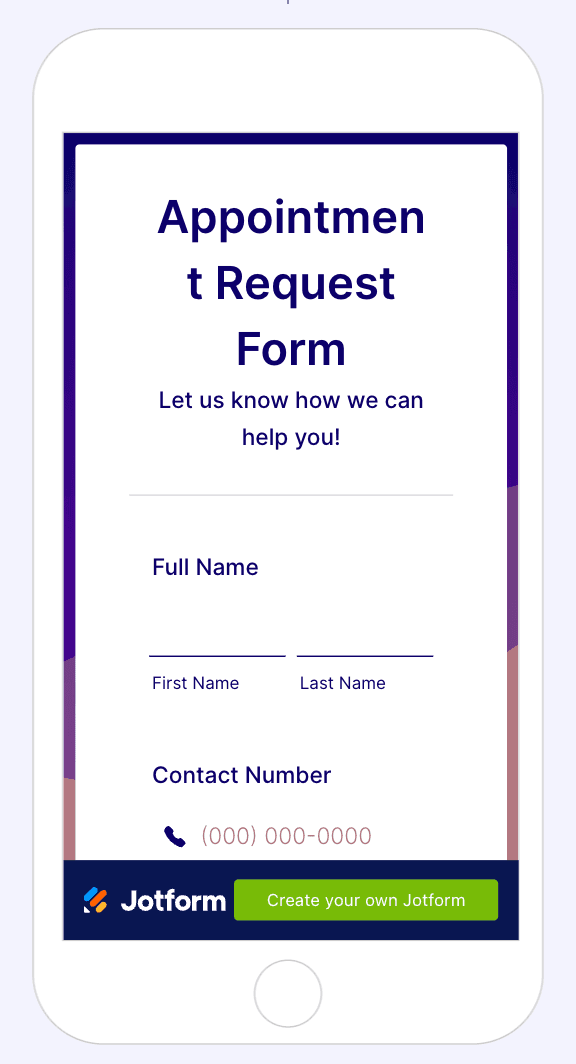
This is an appointment request form on a phone. Before the visitor has done anything, they can see a title that has wrapped mid-word, two name inputs, a phone number field, and more form below the fold. The Jotform branding bar takes the bottom strip. Nothing here is broken — it is a perfectly ordinary form, and that is the point. This is what a landing page's form looks like on the device most of your ad traffic arrives on.
Sequencing the questions helps, and Typeform proved that years ago.
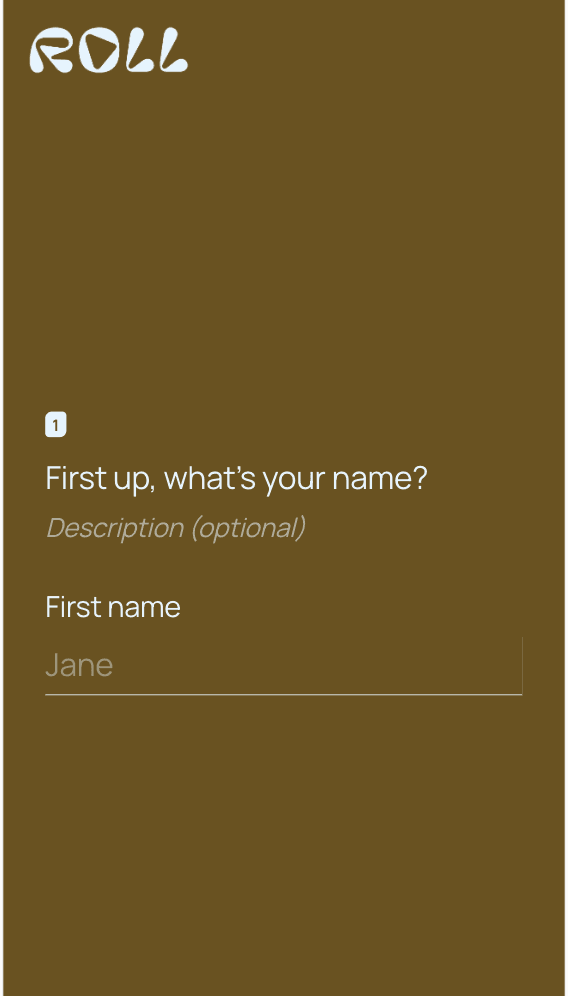
Credit where it is due: Typeform popularised one-question-per-screen and it works. The visible workload here is one field instead of four. But look at what the visitor is being asked to do — tap into a text box and type, on a phone keyboard, as the very first act of the relationship. The sequencing is right; the input method is still the desktop one.
A mobile funnel that feels like an app.
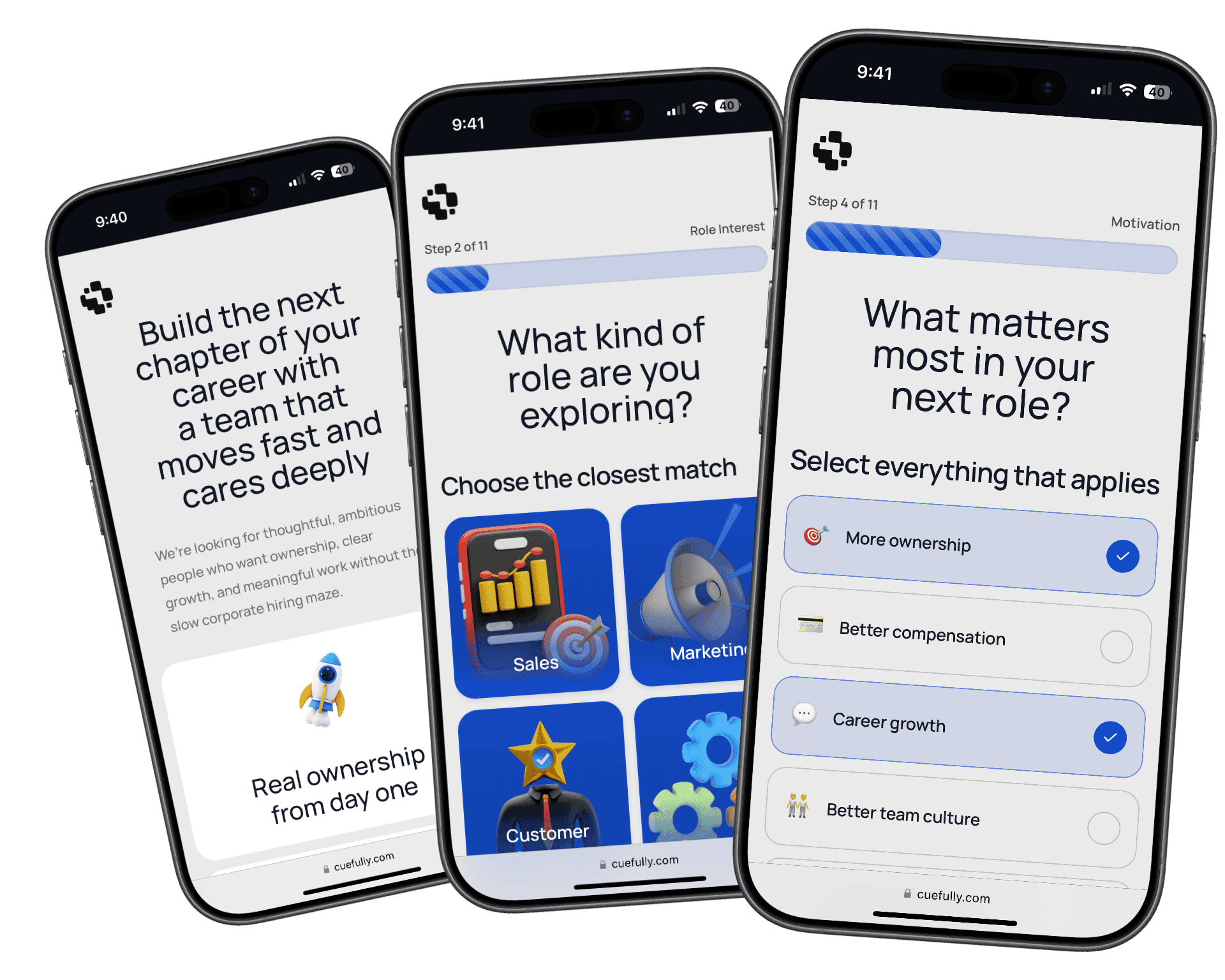
Same job, different shape. The offer is established before anything is asked. Then the first question arrives as four large image tiles and answering it costs one thumb tap. No keyboard, no text field, no decision about how much to write.
That is the whole mechanism the Zuko data points at. Field count is not what predicts completion; the assessment someone makes in the first few seconds about how much work they are being asked to do is. A form shows them four fields. Typeform shows them one field and a keyboard. A funnel shows them a choice.
One honest note on these images: they were captured at different times for different articles, so the framing is not identical — the Typeform screen has no device bezel, the other two do. They illustrate the format difference, not a controlled test.
What is Unbounce genuinely good at?
Unbounce is best for testing landing page variants against high-volume traffic where the page is the experiment. Three things it does better than most of the tools below:
- Experimentation as a first-class product. Unlimited A/B testing on Experiment and above, with the reporting to act on it.
- Smart Traffic. AI traffic routing that sends visitors to the variant most likely to convert them, which is a genuinely different capability from plain A/B testing.
- A mature builder. Years of iteration on a page canvas that does what experienced marketers expect it to do.
Unbounce is best for teams running high-volume desktop and search traffic who intend to test their way to a better page. If that describes you, the rest of this article is about a problem you do not have, and you should stay.
Pricing (checked 29 August 2026). Starter $29/mo (500 traffic) · Build $99/mo (20k) · Experiment $149/mo (30k, unlimited A/B testing) · Optimize $249/mo (50k, AI traffic optimization) · Concierge and Agency custom. Annual billing is 25% lower on each. All plans include unlimited conversions.
The 8 best Unbounce alternatives
1. CueFully — best for paid social traffic that lands on a phone
CueFully is best when your traffic comes from Instagram, TikTok or Meta ads and you need what it lands on to behave like an app, not a page.
CueFully is a mobile-first funnel builder designed specifically for Instagram, TikTok and Meta ad campaigns. It is built for cold paid social traffic arriving on a phone: funnels are thumb-first, ask one question per screen, and are answered by tapping rather than typing.
One question per screen is the whole argument. Unbounce produces a page you scroll. CueFully produces a sequence you tap through. The distinction matters because of what Zuko's benchmarking actually found: field count is not correlated with completion rate, but comparison forms averaging 36 required inputs get abandoned after roughly 50 seconds. What kills the conversion is not how much you ask — it is how much work is visible at the moment someone decides whether to start. A funnel makes that visible workload exactly one question, every time, no matter how many questions follow.
It feels like an app because it loads like one. Published funnels are light. The recruitment template ships a 103 KB HTML document and loads in 0.52 seconds (measured 29 August 2026, mobile user agent, document only). On cold paid traffic, the load is not a technical footnote; it is the first thing the visitor experiences and the last chance you get.
It qualifies while it captures. Funnels branch on the visitor's answers, so the path adapts as it goes, and answer-level scoring lets you weight the options that indicate a real prospect. The expensive question — budget, timeline, phone number — arrives once someone is invested, not first. Copy can personalise from the visitor's own earlier answers, so the flow reads like it was written for them.
A workspace per client, not a folder per client. Funnels, leads, uploads and branding stay isolated per client, and switching is one click. Reusable brand kits mean a client's colours, fonts and logo are set once and applied everywhere. For an agency, this is usually the deciding feature, and most landing page builders have no concept of it — we go deeper on why in our roundup of funnel builders for agencies.
The measurement matches the format. CueFully includes a built-in CRM, so captured leads land in a contacts view with their source and their answers attached. Analytics are per step, so you see where someone left, not only that they left. Meta Pixel and the Conversions API are configured as a single integration with standard events and customer-data matching, so campaigns optimise on server-side conversions rather than browser events alone. Slack, Google Sheets and webhooks handle the rest.
Scope. CueFully builds mobile lead funnels rather than landing pages for search traffic.
Pick it if your ads run on Instagram, TikTok or Meta and the click lands on a phone — especially if you run them for more than one brand. You can see what the funnels actually look like in the template gallery rather than take our word for the shape.
2. Heyflow — best if you have already concluded you want a funnel
Heyflow is best for teams who have reached the same conclusion this article argues for and want to compare mobile funnel products directly.
Heyflow is the closest direct peer to CueFully in this list: interactive, mobile-oriented flows built for lead generation rather than pages built for reading. If the format argument above lands with you, Heyflow belongs on your shortlist alongside us, and we would rather say that than pretend the category has one occupant.
Where the two differ meaningfully: Meta Pixel and the Conversions API are configured as one integration in CueFully; Heyflow treats them as two. And CueFully's model is a workspace per client with reusable brand kits, which is built for agencies running a roster rather than a team running one brand.
Pick it if you want a second mobile funnel product to evaluate. Check carefully how each vendor's plan prices response or lead volume, because in this category that is where the models diverge most.
3. Instapage — best for enterprise ad-to-page optimisation
Instapage is best for large teams whose job is squeezing more conversions out of high-volume paid search and display traffic.
Instapage is Unbounce's closest like-for-like competitor and, at the top end, a more serious optimisation platform. Ad-to-page personalisation, server-side A/B testing and heatmap-based behaviour analysis are real capabilities that most tools on this list do not have at all.
Where it falls short as an Unbounce escape route. It is the more expensive product, not the cheaper one, and its own defining features sit high in the range. Server-side A/B testing begins on Optimize; heatmaps are only on the custom Convert tier. If you were leaving Unbounce because Experiment at $149/month was more than you wanted to spend, Instapage is not the answer.
Pricing (checked 29 August 2026). Create $99/mo (15,000 unique monthly visitors, 10 team members, 2 subdomains) · Optimize $199/mo (30,000 visitors, server-side A/B testing) · Convert custom (heatmaps, advanced ad-to-page personalisation). Annual billing is 20% lower.
Pick it if you are an enterprise team with the traffic volume to make testing pay for itself. Skip it if cost was your reason for leaving. If Instapage is the tool you are actually weighing, we compare its alternatives by how each one personalises.
4. Swipe Pages — best for staying with pages but making them fast
Swipe Pages is best for marketers who accept the page format and want the fastest possible version of it.
Swipe Pages positions itself explicitly around speed and mobile-optimised pages, and of the conventional page builders here it is the one that takes load time most seriously. If you have diagnosed your problem as "my pages are slow" rather than "my pages are the wrong shape", this is the most direct fix in the list.
Where it falls short. It is still a page. A fast page that asks for eleven fields in one view is a fast version of the thing that was not working. Speed and format are separate variables, and this solves one of them.
Pick it if your traffic is mixed and you want to keep a page-based workflow. Skip it if the format itself is the problem.
5. Leadpages — best for small businesses that need pages without enterprise pricing
Leadpages is best for small businesses and solo marketers who want conventional landing pages and popups at an accessible price.
Leadpages has been in this category a long time and does the fundamentals reliably: templates, a workable editor, popups, alert bars and integrations with the email tools small businesses already use.
Where it falls short. It is built for breadth of small-business use cases rather than for paid social funnels specifically, and it has no concept of client workspace isolation. We maintain a dedicated comparison of Leadpages and CueFully if it is the specific tool you are weighing.
Pick it if you run one brand and need straightforward pages. Skip it if you manage a client roster.
6. Landingi — best for agencies producing client pages at volume
Landingi is best for agencies whose deliverable is a high volume of conventional landing pages across many clients.
Landingi is one of the few page builders that takes agency workflow seriously, with white-label and client-management capabilities aimed squarely at that model.
Where it falls short. The unit of work is still the page. If your clients' campaigns run on Meta and TikTok, you will be producing a lot of well-organised pages for traffic that would convert better as flows.
Pick it if your clients need pages and you need to produce them at scale. Skip it if the campaigns are paid-social lead generation.
7. ClickFunnels — best when the funnel ends in a purchase
ClickFunnels is best for selling a product directly, with checkout, order bumps and upsell sequences built in.
ClickFunnels solves a genuinely different problem from Unbounce. It is not a landing page builder with extra steps; it is a sales funnel with commerce attached, and for info-product and direct-response businesses that is the correct tool.
Where it falls short as an Unbounce replacement. If your funnel ends in a submitted form rather than a completed payment, most of what you are paying for goes unused. We cover the trade-offs in detail on our ClickFunnels comparison page.
Pick it if money changes hands at the end of the funnel. Skip it if the goal is a qualified lead.
8. systeme.io — free all-in-one for solo operators
systeme.io is for solo operators who want pages, email and courses in one free tool and can accept depth traded for breadth.
Its free tier is genuinely usable, which is rare in this category, and it ranks for "free Unbounce alternative" for a reason.
Where it falls short. Bundling this much into one product means no single piece is best-in-class,the funnels designed in systeme.io don't look that beautiful or of that professional quality and the page builder is the piece most obviously affected. There is no agency multi-client model.
Pick it if budget is the binding constraint and you are one person. Skip it if page quality or client separation matters.
How do you choose the right Unbounce alternative?
Choose by diagnosing the format first and the tool second. Four questions settle it.
1. Where does the click actually come from? Open your ad account and look at the device split. If the majority is mobile and the source is Instagram, TikTok or Meta, you are choosing between mobile funnel products — CueFully and Heyflow — not between page builders. If it is desktop search, stay in the page category.
2. Is the page the experiment, or is the offer? Unbounce and Instapage are optimisation platforms: they assume you will run variants and improve the page over time. That only pays back above a certain traffic volume. Below it, you are paying for a testing apparatus you will not use, and you would get more from changing the format than from testing the current one.
3. How many fields are visible at once? This is the cheapest diagnostic in this article. If your page shows someone eight fields in a single view, the Zuko finding applies to you directly — it is the visible workload, not the total, that decides whether they start. Our guide to multi-step forms covers how to restructure that, and the form abandonment statistics we compiled show what it costs when you don't.
4. One brand or many? Multi-client work makes workspace isolation and reusable brand kits the deciding feature, and most tools in this category have no concept of either. That single requirement usually eliminates two-thirds of the list before price is discussed at all.
If none of these apply and Unbounce is converting, stay. Switching has a real cost, and "there is a cheaper page builder" is not on its own a reason to pay it.
FAQ
What is the best Unbounce alternative for Instagram and TikTok ad traffic?
CueFully is the best Unbounce alternative when the click comes from Instagram, TikTok or Meta ads, because it produces a mobile funnel rather than a landing page. The visitor is asked one question per screen and answers by tapping rather than typing, which suits how someone behaves after tapping an ad mid-scroll. Heyflow is the other product in this category and belongs on the same shortlist.
Is there a cheaper alternative to Unbounce that still includes A/B testing?
Yes — Leadpages. Its Optimize plan at $100/month includes A/B testing, Smart Traffic and heatmaps, against Unbounce's unlimited A/B testing from the Experiment plan at $149/month and Instapage's server-side A/B testing at $199/month (all checked 29 August 2026). Leadpages also imposes no traffic caps or per-lead fees on any plan, where Unbounce meters visitors. If experimentation is the capability you are paying for, Leadpages is the cheapest credible route to it.
What is the difference between a landing page builder and a mobile funnel builder?
A landing page builder produces a single page that a visitor scrolls and reads, with a form usually placed at the end. A mobile funnel builder produces a sequence of screens that a visitor taps through, asking one question at a time and branching based on the answers. Unbounce, Instapage, Leadpages, Landingi and Swipe Pages are landing page builders. CueFully and Heyflow are mobile funnel builders.
Why do my Unbounce landing pages convert worse on mobile than on desktop?
Because a page laid out for reading asks a mobile visitor to do more visible work before they begin. Zuko's benchmarking puts form completion at 42% on mobile against 47% on desktop, and found that field count is not correlated with completion — comparison forms averaging 36 required inputs are abandoned after roughly 50 seconds. The page reflowing correctly on a phone does not change how much work the visitor sees at the moment they decide whether to start.
Which Unbounce alternative is best for an agency managing many client accounts?
An agency should judge these tools on client separation before anything else. CueFully gives each client an isolated workspace with its own funnels, leads and brand kit, and switching between them is one click. Landingi is the strongest option if the deliverable genuinely needs to be conventional landing pages at volume. Most other tools in this category treat multi-client work as folders rather than as isolated workspaces.
Does CueFully do A/B testing like Unbounce?
No. CueFully has no A/B testing, no split testing and no heatmap recording. Page and variant experimentation is what Unbounce and Instapage are built for, and if that capability is the reason you use Unbounce, those are the products to compare. CueFully's per-step drop-off analytics show which question in a funnel loses people, which answers a different question from which page variant wins.
How fast does a CueFully funnel load compared with a landing page?
The CueFully recruitment template ships a 103 KB HTML document and loads in 0.52 seconds, measured on 29 August 2026 with a mobile user agent, document only. The appointment booking template is heavier at 485 KB and 0.81 seconds. Load time is a conversion variable on cold paid traffic rather than a technical detail, which is why it is worth measuring on the specific template you intend to use rather than trusting a vendor's best case.
Should I switch from Unbounce if my traffic is mostly Google Search on desktop?
Probably not. Unbounce is genuinely strong for high-volume desktop and search traffic where the landing page is the experiment, and its Smart Traffic routing has no direct equivalent in most of the tools listed here. The argument for switching to a mobile funnel applies to paid social traffic arriving on a phone. If that is not your traffic, the format change solves a problem you do not have.
Build from the guide
Build this funnel in minutes
Start from a proven mobile-first flow, customize it for your client, and publish a funnel that captures qualified leads without adding developer work.