Recruitment funnel template for better-fit applicants
Turn job interest into a short mobile application flow: sell the role, qualify intent, and collect the details your hiring team needs.
Opens in CueFully · free to start, no credit card
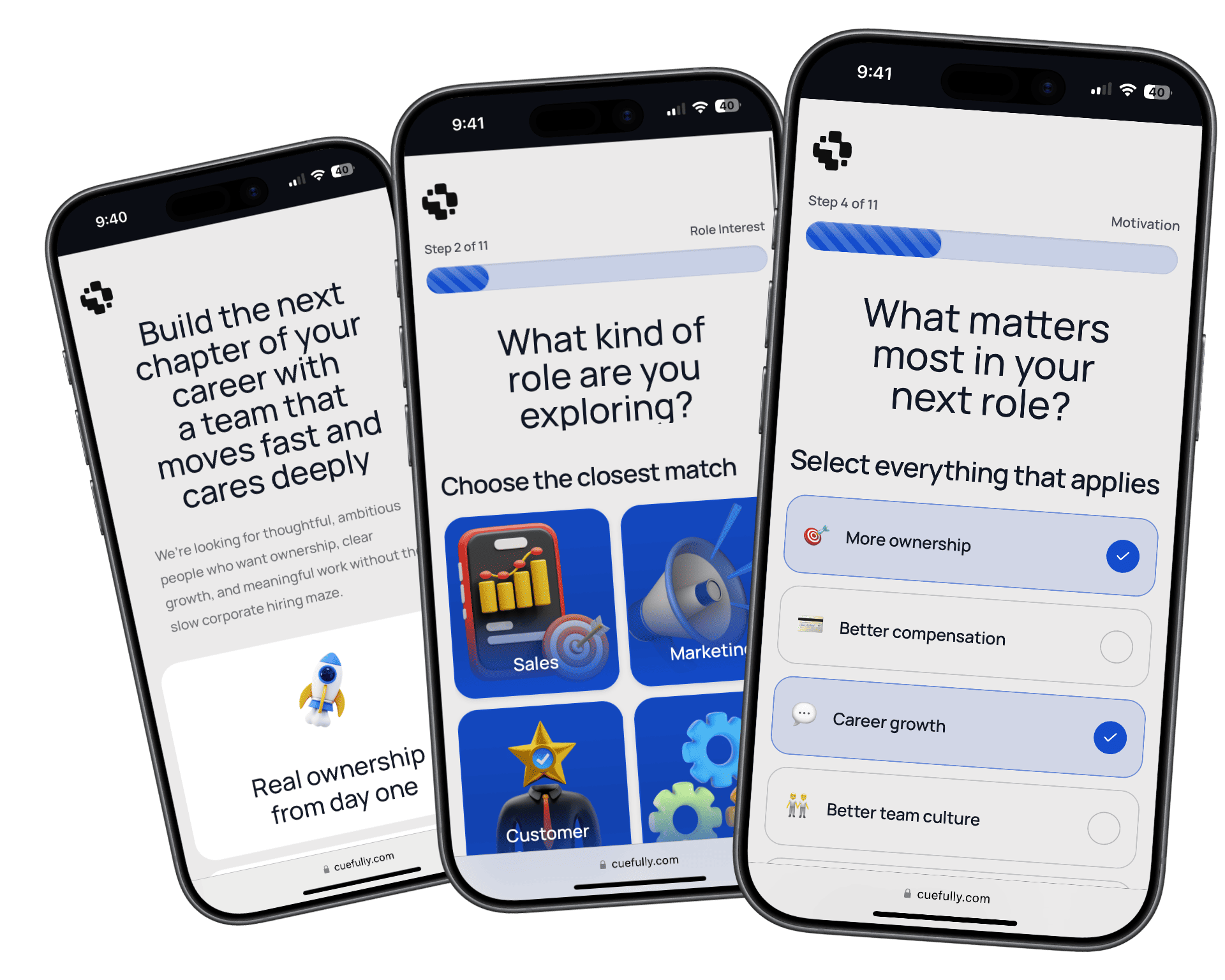
The 11-step recruitment funnel
Every step is a mobile-first wall you can edit, reorder, or rebrand for each client. Here's how this funnel is built.
- 1
Role invitation
Open with a clear reason to apply and make the opportunity feel worth a candidate's time.
- 2
Why join
Explain the benefits, team context, and upside before asking for personal information.
- 3
Application path
Show candidates the short process so the application feels easy to complete.
- 4
Role interest
Confirm what type of position, seniority, or department the candidate is interested in.
- 5
Experience fit
Screen for relevant experience without making candidates upload a long CV first.
- 6
Availability
Learn when the candidate could start and whether their timeline fits the hiring need.
- 7
Work preference
Capture location, remote, hybrid, or schedule preferences before review.
- 8
Motivation
Ask why the candidate is interested so hiring teams can spot stronger intent.
- 9
Contact details
Collect the candidate's name, email, and key application details in one mobile-friendly step.
- 10
Optional proof
Let candidates share a portfolio, LinkedIn profile, or short work sample when relevant.
- 11
Confirmation
Set expectations for the next hiring step and reduce follow-up confusion.
What is a recruitment funnel?
A recruitment funnel is a short candidate application flow that explains the role, makes the opportunity attractive, asks a few screening questions, and captures the candidate details needed for follow-up. Instead of sending applicants to a long static form, a recruitment funnel gives each step one clear job: build interest, qualify fit, then collect contact information. That makes it useful for hiring teams that want more context than a resume upload and a smoother experience for candidates applying from mobile.
If you're planning the flow before you build it, our guide to how a recruitment funnel works walks through the steps this template already follows.
Sell the role first
Rewrite the opening steps around pay, shift pattern, location, and progression — the details candidates actually screen you on before applying.
Encode your must-haves
Turn licences, certifications, right-to-work, and availability into qualifying questions so unsuitable applicants drop out before manual review.
Collect what hiring needs
Set the final step to capture the details your team screens on, so every application arrives complete instead of needing a follow-up email.
Who it's for
Best for hiring teams, recruiters, agencies, and companies that want a faster mobile-first application flow with better qualification before manual review. It fits high-volume roles most of all — hospitality, retail, field sales, driving, trades — where applications arrive from a phone and a long form kills the best candidates first.
Why it converts
The template sells the role before it screens the candidate, which keeps stronger applicants engaged. Then it breaks qualification into short steps so the hiring team gets cleaner, more useful candidate context. Strong candidates abandon long application forms fastest because they have other options — keeping each step to one question is what holds them through to submission.
- Applying takes a phone and a minute — no desktop, no CV upload to stall on
- Screening questions run before submission, so review time goes to real candidates
- Every applicant lands in Contacts in real time, ready to filter and export
Frequently asked questions
More funnels
Browse the full funnel template gallery, or read our guide to building a lead generation funnel.
Launch this recruitment funnel in minutes
Customize it for your client, publish a sub-second funnel, and watch leads land in real time.
Use this funnel